Research

Research spanning biostasis, click chemistry, photopolymerizations, optical materials, and covalent adaptable networks — united by a deep commitment to the formation, structure, and properties of crosslinked polymeric materials.

Forming, Shaping, and Controlling Polymer Networks

Research in the Bowman Group combines polymerization reaction engineering, monomer and polymer synthesis, and experimental characterization to design, synthesize, and understand polymer networks with distinctive properties and applications. Our work spans several areas that connect molecular-level design to macroscopic material performance — biostasis induction, photopolymerization reactions, click chemistry, optical materials, and covalent adaptable networks.

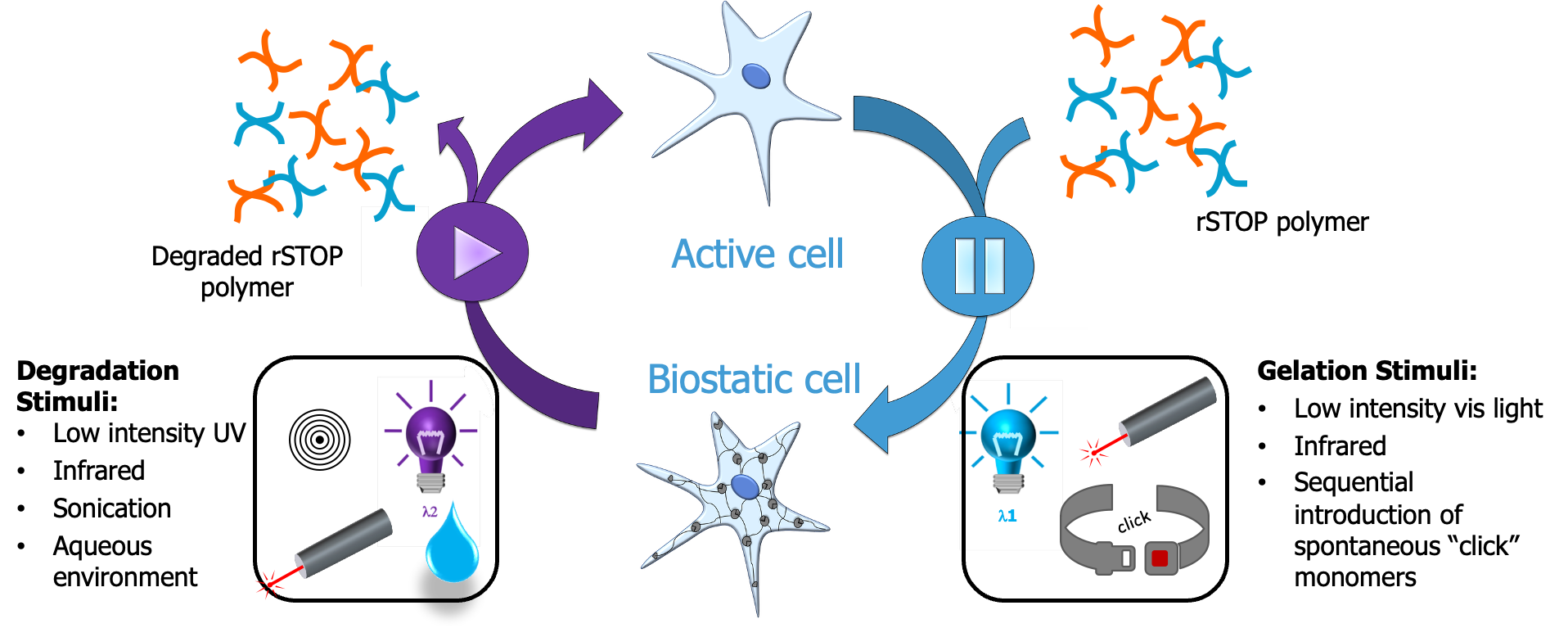
Reversible biostasis cycle: rSTOP polymer gelation converts an active cell to a biostatic cell under visible light, infrared, or sequential click monomers, and degradation under low-intensity UV, infrared, sonication, or aqueous environment returns it to active
01

Biostasis

Tardigrades, some frogs and a few other organisms have the capacity to go into biostasis, a state in which all biological activity is essentially halted, as a means to survive extreme conditions. In this state, induced often by dehydration, these organisms are able to survive through extreme droughts, travel in space, and extended times at a wide range of temperatures. One can imagine that if human cells and tissues were able to undergo a similar transition to a biostasis state, that the implications for medicine would be profound.

We are developing methodologies that introduce polymer precursors to the cell interior through transfection and other methodologies with polymerization and cross linking of the precursors often initiated by exposure to light. Upon exposure to light and with the subsequent intracellular gelation, a transition is induced that dramatically reduces biological activity until the gel is degraded, either hydrolytically or by exposure to a different wavelength of light. Upon degradation, the biological activity of the cell is found to return to normal. Our work has focused on the material development, gelation, and degradation while targeting these developments to wound healing applications.
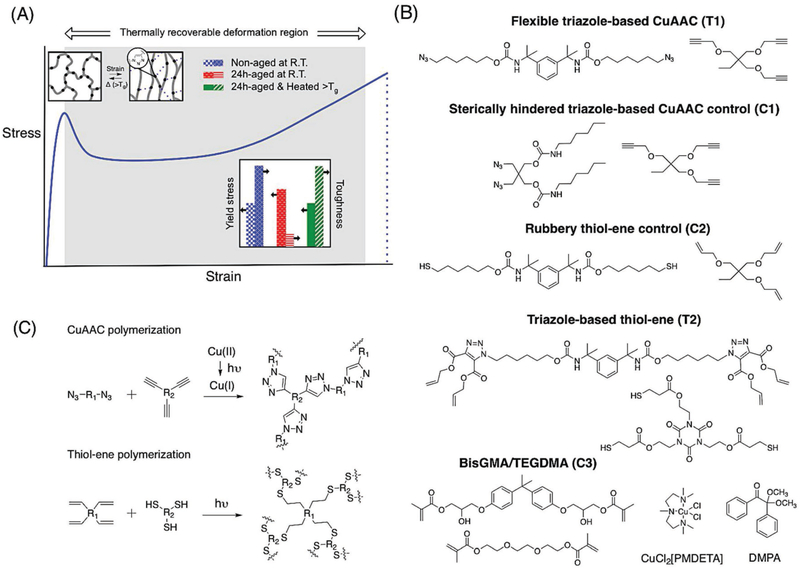
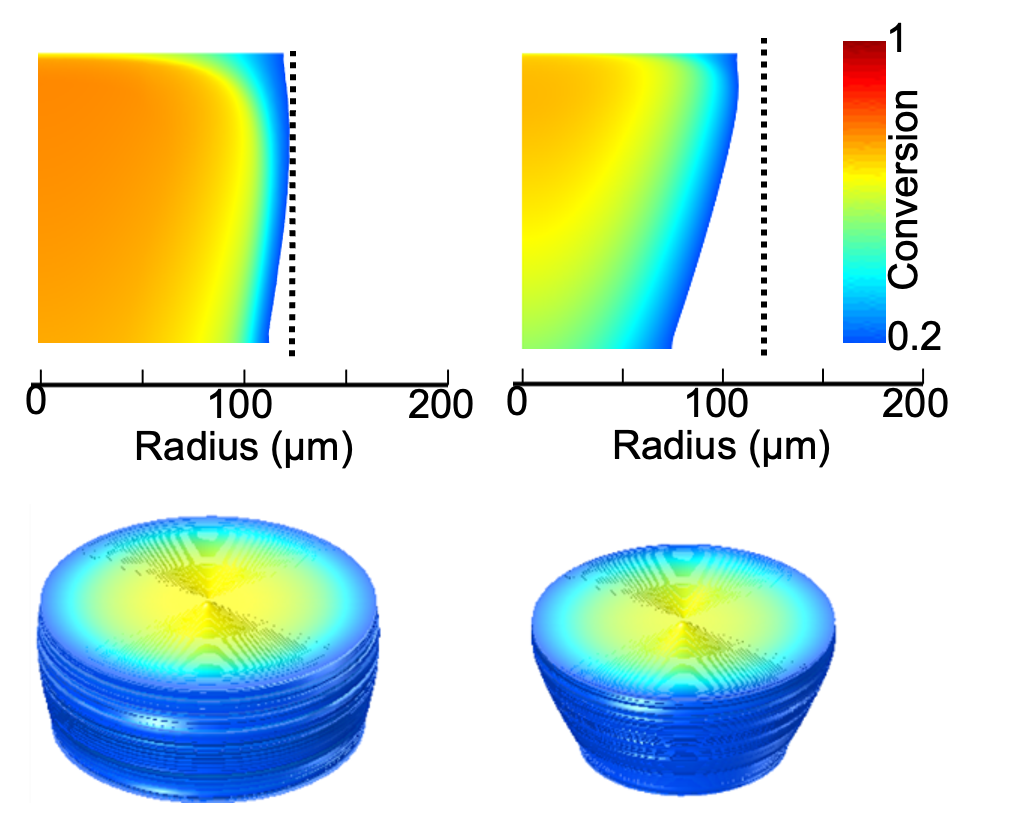
Triazole-based glassy polymer network structure

Adapted from Truong et al., Macromolecules 2019 — photopolymerized triazole-based glassy polymer networks. Open-access via PMC6519945.

02

Click Chemistry

Click chemistry is characterized by high yield, mild reaction conditions, orthogonality, and fast kinetics. The group applies these principles to materials science — developing photopolymerizable networks using thiol-X reactions (thiol-ene, thiol-yne, thiol-Michael, thiol-anhydride) and Huisgen azide-alkyne cycloaddition for functional polymeric materials.

These networks find application in photoresins for lithographic patterning, microparticle and nanoparticle synthesis, holographic materials, coatings, and shape-memory systems. The modularity of click chemistry allows systematic tuning of crosslink density, mechanical properties, degradability, and optical character.

Thiol-ene Thiol-Michael CuAAC Photopatterning Holography Nanoparticles
03

Photopolymerizations

In addition to the advantages associated with spatiotemporal control, photopolymerization reactions are inherently simple, energy efficient, and often solvent free, making them an ideal candidate for forming various polymer structures. With applications in lithography, coatings, biomaterials, adhesives, and additive manufacturing, these reactions are ubiquitous in modern society.

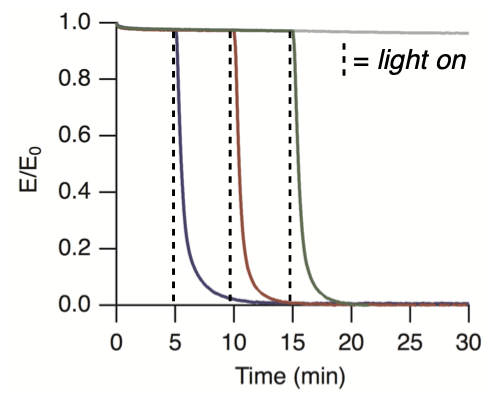
While inherently simple to perform, these reactions often lead to rapid, multiple order of magnitude changes in mass transfer rates as the material goes from a non-viscous liquid to a highly cross linked, glassy polymer in a very short period of time. This attribute leads to the establishment of strong gradients in both composition and temperature. Our group has focused on the development of advanced materials that improve the performance of the materials produced as well as first principles modeling of the photopolymerization kinetics and material property evolution as a function of space and time.

04

Optical Materials

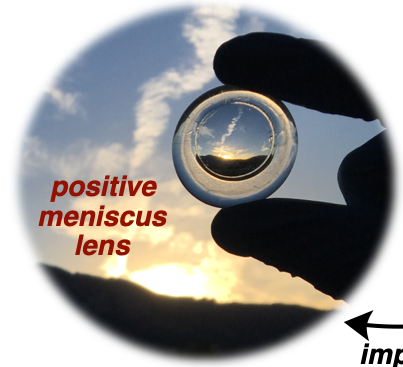
High-performance plastic optical materials are essential for future computing applications (augmented reality, computer vision systems, etc.). Bespoke synthetic monomers serve as the foundation for photopolymerizable optical materials possessing ultra-high refractive index (n>1.6) with superb clarity.

Leveraging dynamic chemistry, the Bowman Research Group specializes in ultra-low-stress materials with minimum birefringence, even under advanced rapid photo-processing conditions. These techniques culminate in holographic photopolymers, a promising material class for see-through displays, in which the Bowman Research Group is a U.S. leader.

Our expertise spans in-house monomer synthesis, photopolymerizable chemistries (i.e. thiol-ene, acrylate), high-index organic materials, orthogonal chemistry, real-time cure kinetics, time-temperature mechanical analysis, optical characterization, and chemical modeling of curing behavior.

05

Covalent Adaptable Networks (CANs)

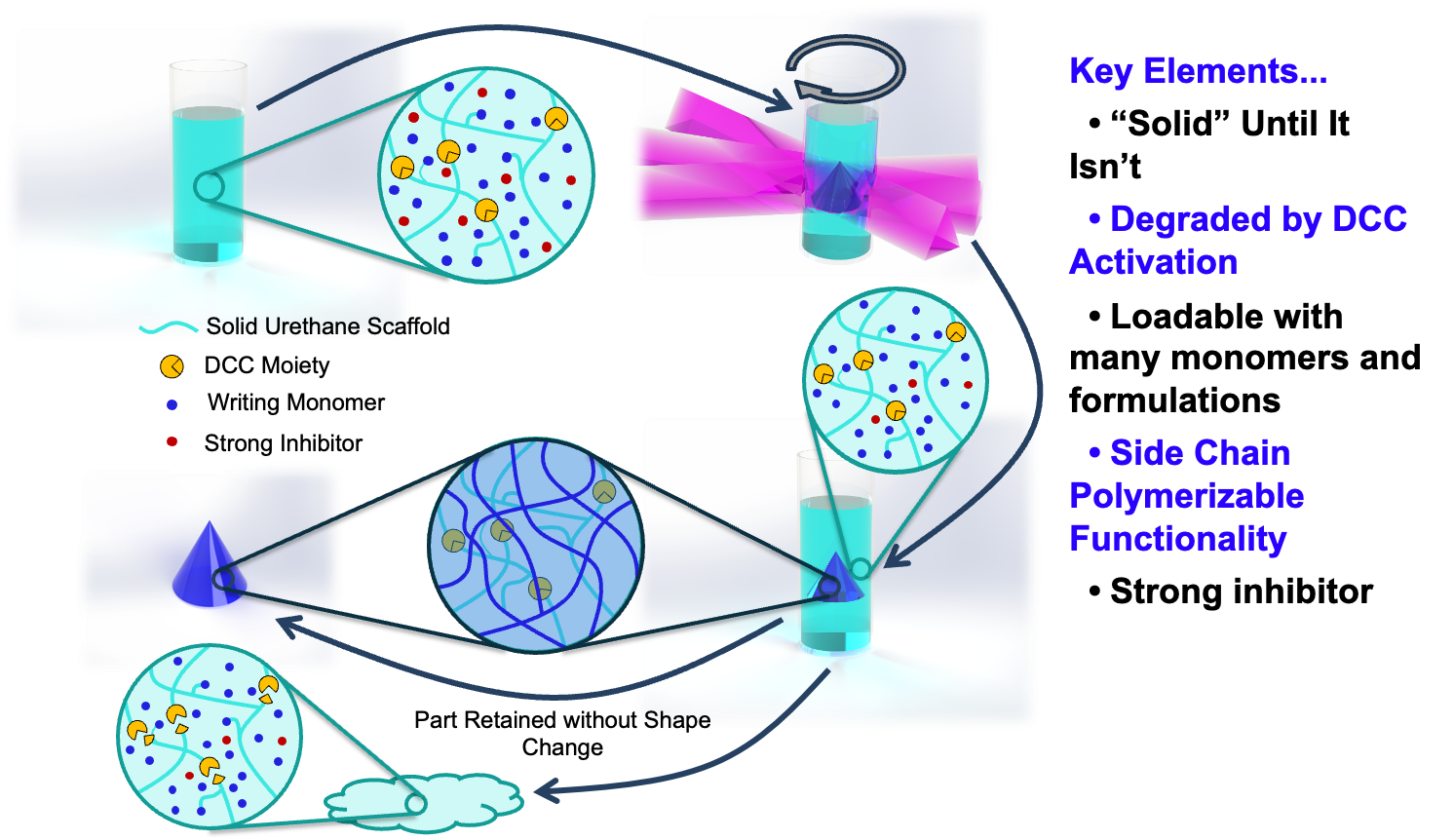
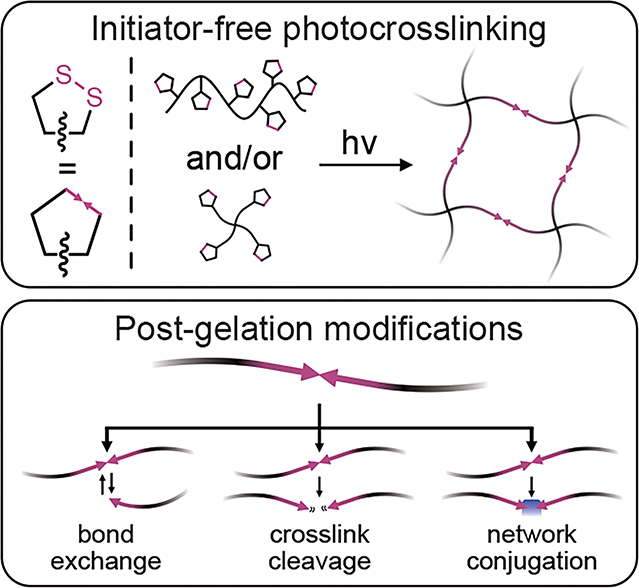
The group studies chemistries that bridge the gap between the processability of thermoplastics and the many desirable properties — including solvent resistance, creep resistance, and dimensional stability — of crosslinked polymers. Dynamic covalent bonds allow bond reshuffling under specific stimuli while maintaining network integrity.

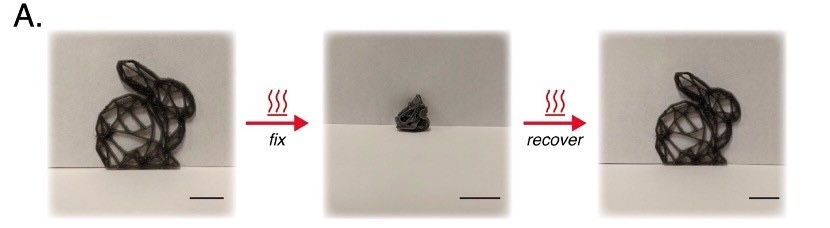
Methods include photo-induced RAFT polymerization, thermally reversible Diels-Alder reactions, thiol-thioester exchange, allyl sulfide exchange, and transesterification. Recent highlights include fully recyclable 3D-printed thermosets, leaping liquid crystal elastomers published in Science Advances, and photo-triggered stress relaxation in glassy polymer networks.

Vitrimers Photo-RAFT Diels-Alder Thiol-Thioester Exchange Liquid Crystal Elastomers 3D Printing

Methods & Capabilities

Reaction Engineering

Real-time FTIR, photo-DSC, UV-Vis, kinetic Monte Carlo modeling, and reactor design for photopolymerization systems.

Polymer Synthesis

Monomer design, controlled radical polymerization (RAFT), solid-phase synthesis, click chemistry, and miniemulsion polymerization.

Materials Characterization

DMA, rheology, AFM, SEM, NMR, GPC/SEC, and mechanical testing across length scales.

Photochemistry

Quantum yield measurements, photoinitiator design, wavelength-selective reactions, and two-color photopolymerization systems.

Additive Manufacturing

Vat photopolymerization (SLA/DLP), direct write lithography, holographic recording, and soft lithography for microfluidics.

Collaborative Research

Active partnerships with the Stansbury, Anseth, White, McLeod, and Clark groups at CU, and with UC San Diego, Harvard, and industry.